NONFICTION
Steven Pfau | The Story of The Story of Harold
Ruby Hansen Murray | An Osage Looks at the Pioneer Woman
Amanda Barrett | Morning Person
Maisie Wiltshire-Gordon | Reconfigured
Anney Bolgiano | My Grandmother Took So Much Tylenol That after Her Death an Autopsy Revealed She Had Grown an Accessory Lobe on Her Liver
Elizabeth Hall | Rat Beach
Tom Lutz| Gravy Donuts, 24/7
POETRY
Christopher Citro | Air Damp as the Back of the Throat | We’ve Come All This Way Got Dressed Up
Nicholas Chng | 1942
Annelyse Gelman | Double Action Only
April Freely | Draw
Emily Blair | The Overlook | Superman II | The Wonder Twins
Kwame Dawes | Cupid in the Streets
Bret Yamanaka | Calling the Wind | Hanako | Koduko
Mónica Gomery | Sleeping in Hurricane Season
Avia Tadmor | Leaving Jerusalem | Separation as Eve | Ruth \ ‘rüth \ (n.) | Book of Ruth, Afterthought | Night Will Soon Fall on the Lake
Kimiko Hahn | The Calculation of Nothing | Ode to the Edna St. Vincent Millay Line “I only know that summer sang in me / A little while, that in me sings no more.”
Hiram Larew | Spite
Niki Neems | One Life’s Private Kingdom
H.R. Webster | June
Nell Wright | I examined the map | sir this is not my folktale | What I Take Away | you are confused | the future emerged alive
John Wall Barger | Self-Harm Song
David Hernandez | Hello I Must Be Going
FICTION
Craig Thomas | Questionnaire
Stephanie Ramlogan | To Kill a Soucouyant
Melissa Yancy | Predators
Leslie Pietrzyk | Headstrong
Teresa Veiga, translated by Jeremy Klemin | The Bleak House
Katherine Damm | The Happiest Day of Your Life
Mark Chiusano | Scrabble
John Searcy | Library
Paul Sladky | Relativity
ARTWORK
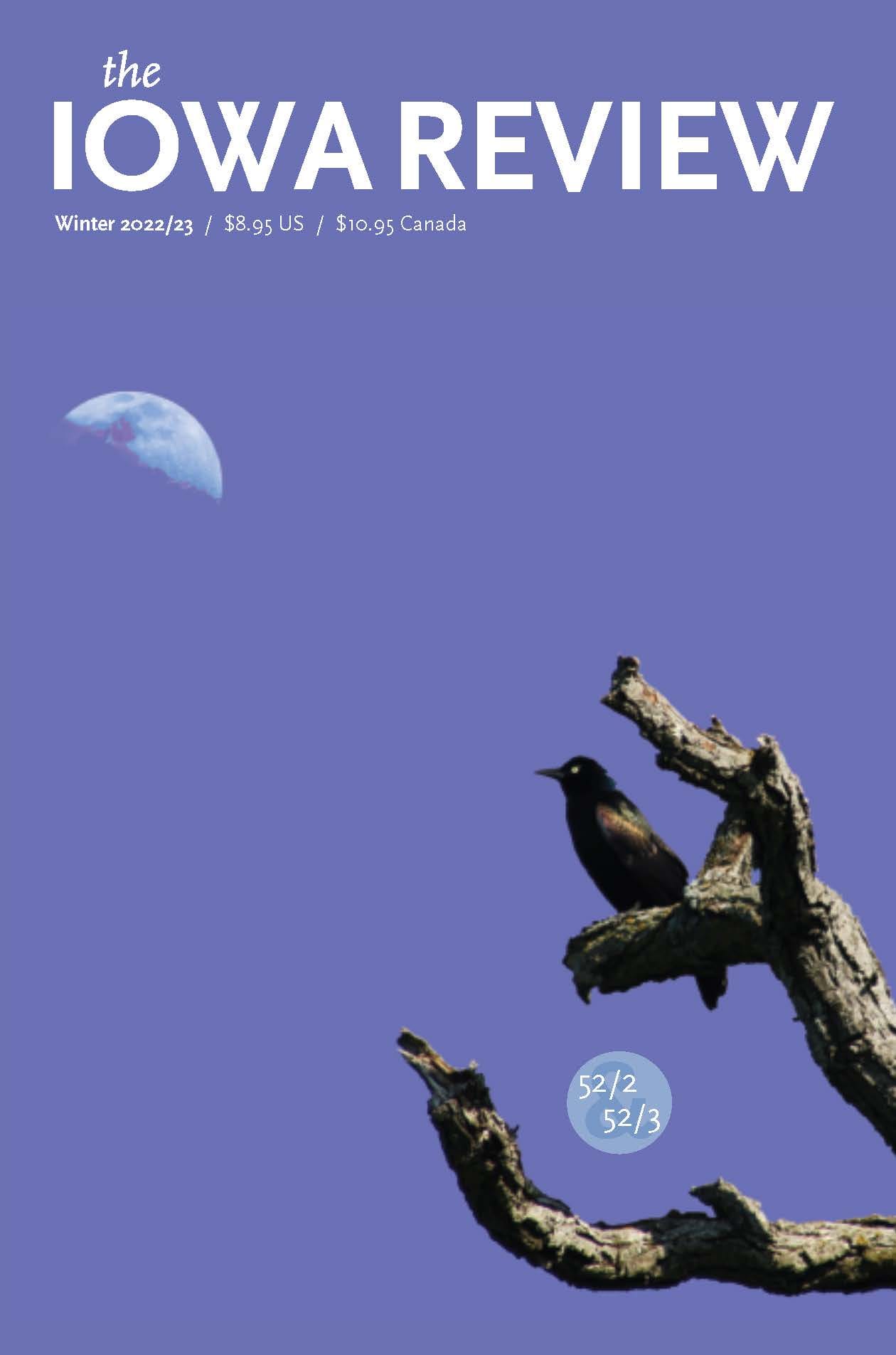
Ray Young Bear| Daytime Moon with Blackbird on a Derecho-Downed Oak Tree
Editors’ Note
Lost Time
As for the whole world, 2020 and 2021 were strange for The Iowa Review. We only published two issues apiece in those years instead of our usual three per year. This second double issue in a row is part of our race to catch up to our normal schedule.
But what is “normal” anymore?
My work memories of 2020, Year One of the pandemic, were of sudden disruption, TIR’s exile from our offices at the University of Iowa, and a summer of working in my car in the Wi-Fi parking lot behind the law school. Highlights included when deer would emerge from the patch of woods beyond my windshield to graze, calmest of colleagues; setbacks included when I would inevitably drop my pen under the driver’s seat and it would enter some void, never to be found again. I thought nostalgically of the creaky architectural relic and example of bad feng shui the English- Philosophy Building (EPB), our campus home, where at least there were desks and chairs and floors.
More so than my own absence, I thought of the building empty of students, as classes pivoted hastily to meeting online. That’s why the From Our Archives section (inside back cover) features “The University Abandoned Overnight,” from TIR’s issue 1/2 (Spring 1970). This poem by Bill Knott feels like a description of campus in March 2020, capturing the “complete echoes” of a place suddenly transformed into a historical ruin. EPB was a museum of itself, a diorama collecting dust, with living memory fading every day a student did not enter.
Year Two brought the hesitant return. After fourth grade via his Chromebook, my older son returned to elementary school in person. My younger son, who had enjoyed a gap year from preschool at age four, experienced the sudden sensory overload of kindergarten. I masked them up and hoped the vaccines for children would hurry.
There was a major drive toward repopulating the university as well, of course. Someone who had been to a lot of emergency meetings concerning the pandemic told me that continuing to be virtual was not an option for university leaders: “They fear that if the university doesn’t go back in person, there’ll no longer be a university.”
TIR’s production stumbled over the pandemic’s barriers—office space gone and kids at home being the salient ones for me—but one thing never faltered: submissions. Pre-pandemic writing gave way to certain topical themes: marriage claustrophobia and spying on the neighbors were two I noticed. But writers never stopped writing, just as readers never stopped reading. Orders poured in during shelter-in-place: maybe the thrill of receiving something in the mail was a lure (plus, bookstores were closed). I remember driving envelopes containing issues over to the Mail Services building to fulfill orders and feeling it to be a kind of human contact, which it was.
Now, during Year Three A.P., I’m seeing a synthesis of pre- and mid-crisis behavior. We’ve learned how accessible and convenient Zoom meetings can be. We’ve learned we can work from home: EPB staff now have schedules that are a hybrid of remote and in-person hours. The building is less populated than before; more than once I’ve opened an empty office to see a calendar still displaying March 2020, when our previous work lives ended. Students roam the halls again, but online classes are also seeing high demand. Nevertheless, the university is still the university; work is still work; writing is still writing.
We’re connecting, but in different ways. In this issue, I see traces of the pandemic everywhere—an essayist working in a warehouse finds camaraderie with her only companion, a forklift; a fictional character reaches out to an Amazon fulfillment agent; and more I’ll leave you to discover—but writing itself persists as a way to make sense of it all.
The other day, Katie, TIR’s managing editor, and I were meeting via Zoom. “It’s so nice to have this time of human connection,” she said. I looked at her image in its box on the screen of my laptop and laughed. We would have never thought this at the beginning of the pandemic. But she was right.
—Lynne Nugent